The binomial distribution is used for those situations in which there are only two outcomes, such as success or failure, and the probability remains the same for all trials. It is very useful in reliability and quality assurance work. The probability density function (pdf) of the binomial distribution is

where
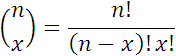
f(x) is the probability of obtaining exactly x good items and (n – x) bad items in a sample of n items where p is the probability of obtaining a good item (success) and q (or 1 – p) is the probability of obtaining a bad item (failure). The cumulative distribution function (CDF), i.e., the probability of obtaining r or fewer successes in n trials, is given by

Example 1
In a large lot of component parts, past experience has shown that the probability of a defective part is 0.05. The acceptance sampling plan for lots of these parts is to randomly select 30 parts for inspection and accept the lot if 2 or less defective are found. What is the probability, P(a), of accepting the lot?
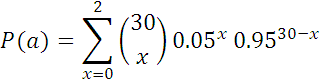

Note that in this example the probability of success was the probability of obtaining a defective part.
Reliability Analytics Toolkit Example, Binomal Distribution Tool
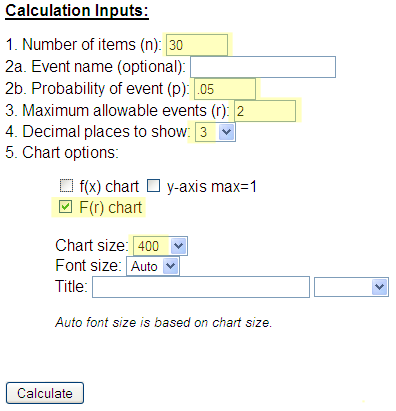
Here we apply the Binomal Distribution from the Reliability Analytics Toolkit to the problem above, with our inputs highlighted in yellow.
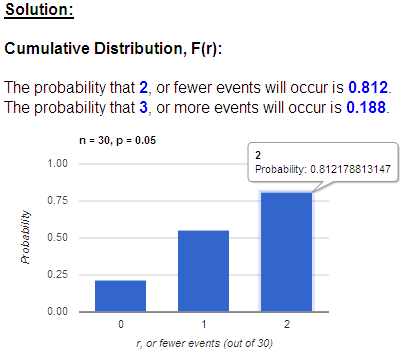
resulting in the following solution
Example 2
The binomial is useful for computing the probability of system success when the system employs partial redundancy. Assume five parallel receivers as shown in the figure below.
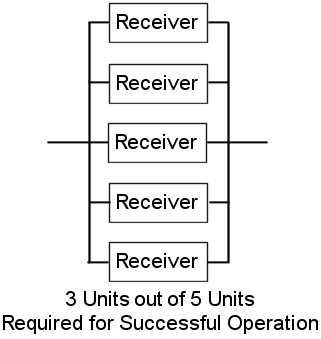
As long as three receivers are operational, the system is classified as satisfactory. Each receiver has a probability of 0.9 of surviving a 24 hour operation period without failure. Thus, two receiver failures are allowed. What is the probability that the system of five receivers will survive a 24 hour mission without loss of more than two units?
Let
n = 5 = number of receivers
r = 2 = number of allowable receiver failures
p = 0.9 = probability of individual receiver success
q = 0.1 = probability of individual receiver failure
x = number of successful channels
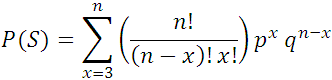
P(S) = probability of system success

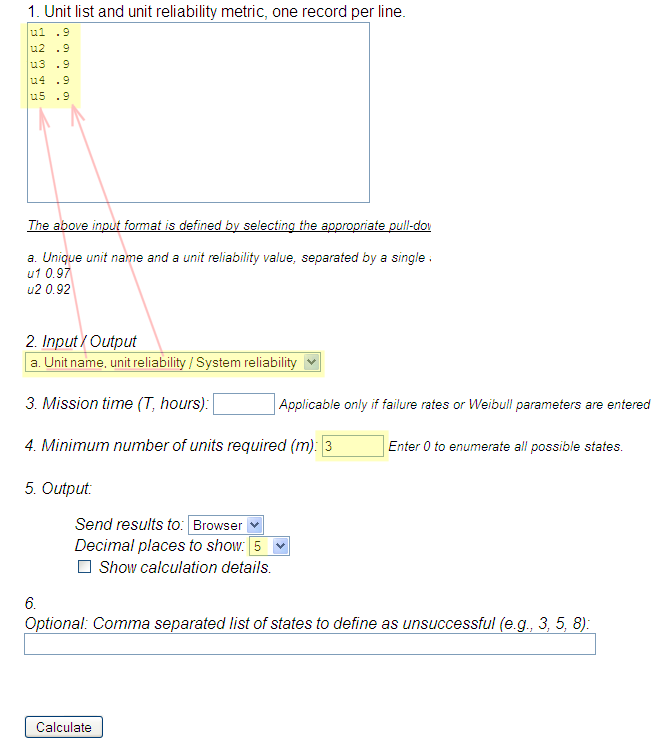
Reliability Analytics Toolkit Example, System State Enumeration Tool
Here we apply the System State Enumeration tool from the Reliability Analytics Toolkit to the problem above, with our inputs highlighted in yellow. u1, u2, etc. is used as a shorthand for “unit”, with the five receiver units listed in box 1. The input format is a unique unit name, followed by a single space, followed by the unit reliability (0.9). Since we are entering a unit name and associated reliability in box 1, we select this option in the item 2 pull-down. The problem statement indicated that 3 receivers are required, which is entered as input 4. Finally, we elect to display results to five decimal places.
Solution:
For 3 of 5 units required, there are a total of 16 successful operating states. 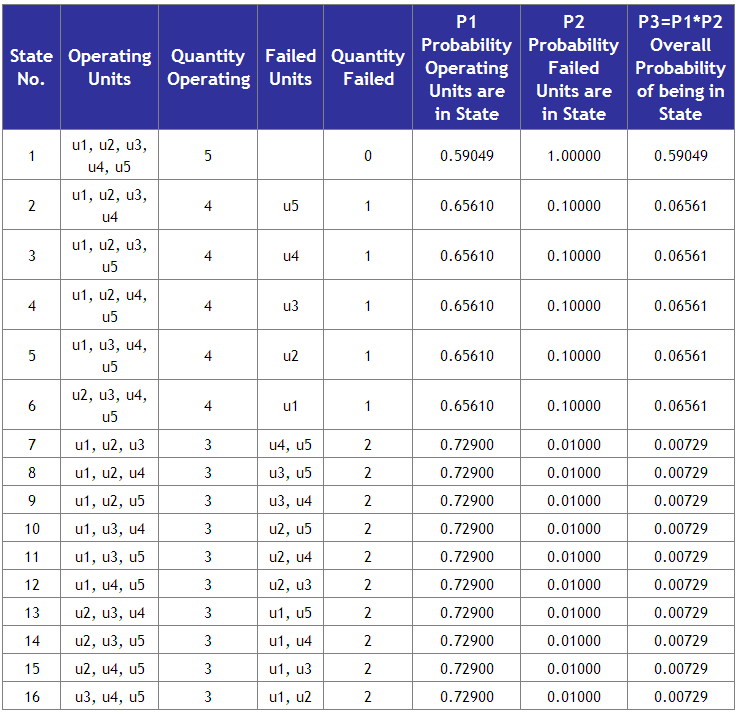
The overall probability of successful system operation for 5 units, where a minimum of 3 are required, is the sum of the individual state probabilities listed in the right-hand column above:
Roverall = 0.99144
References:
1. MIL-HDBK-338, Electronic Reliability Design Handbook, 15 Oct 84
2. Bazovsky, Igor, Reliability Theory and Practice
3. O’Connor, Patrick, D. T., Practical Reliability Engineering
4. Birolini, Alessandro, Reliability Engineering: Theory and Practice